

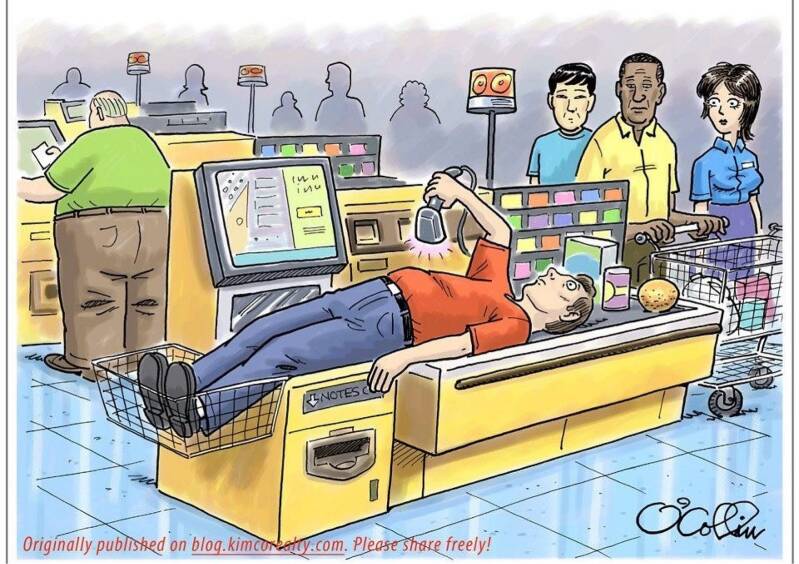
Beep. Transaction done! Doing groceries at the supermarket nowadays feels like an action shrouded in haste. Whenever I am in need of an apple, a croissant and a coffee during my study break, I rush to the closest supermarket near the university campus. There, silent automated cashiers are waiting for my latest purchases. These new employees don’t say “hello” or “good morning,” but rather: “Start scanning.” We understand each other through the red laser beam coming from the scanner. I give it its daily dose of barcodes, and it gives me a price in return. The cashier doesn’t have the same rights as a human, works all day long, and seems to have no need for breaks. Eternally hungry for barcodes — more, more, more. There are never enough products scanned.
These days, you can do your grocery shopping in an ordinary modern supermarket without any interaction with another person. Human cashiers, it seems, are becoming a thing of the past. The only glimpse of humanity I get is from a girl who has to check my purchases to make sure there’s no theft. The only reason for the connection between her and me is now rooted in suspicion, in a potential accusation of theft. Hence, the space for genuine kindness seems to have been banished from the logistics surrounding the selling of products. As a shopper, the only thing I’m supposed to expect from her is quick and efficient service, and approval of my sense of morality. For her, this is most likely routine, a mundane task that might still hold a tiny bit of tension in an imaginary moment in which her subconscious suspicions might finally be confirmed: “We have found a thief!”
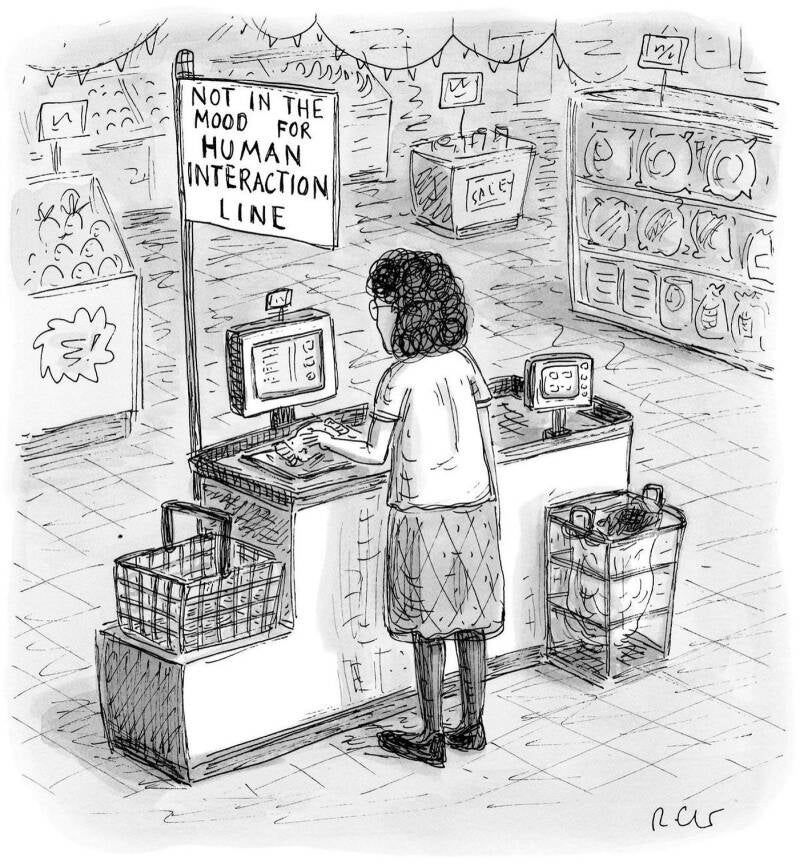
Since doing transactions has never been easier, but also never been so absent of human activity, a new standard has been set into my daily routine. Whenever I go to a shop, a bar, and even a restaurant, I see the transactional moment as a moment in which I have nothing to fulfill but the economic activity itself, detached from any connection to my surroundings. Only I matter — in relation to my debit card and my bank account, and the potential damage I might inflict on my balance. In rare cases, when a waiter or an employee has been kind or when an interaction seems unusually meaningful, it becomes more than that: a moment in which, beyond focusing on entering my PIN or placing my card on the terminal, I also look up into the eyes of the person in front of me.
In this interaction, something special unfolds — something a database processing my transaction into numerical data could never capture as a whole. This is a meeting of recognition. A moment when I see the human in the other. You might think nothing could be more ordinary, but it is precisely this that makes such a moment meaningful to me. The moment I hear the double beep signaling the completion of my transaction, I realize that was secondary. What mattered more was a fleeting moment — difficult to grasp in words, let alone in databases or algorithms. These tiny moments in time in which you are reminded of the idea that we are not just occupying a mere economic space, but also a human one, filled with sensations that arise from the coming together of acts of kindness, imperfections, understandings, and misunderstandings.
As an employee at a small coffee shop, I got familiar with this abstract notion of volatile assemblages, in which my humanity was acknowledged not by a bleep that legitimised my role in the capitalist order of consumer-producer relations, but by a moment of meaning-making beyond the economic sphere. I stood there at the counter waiting for yet another customer to take an order.
“Hi, good afternoon, how can I help you?”
“Hi! Can I get a [a few mumbled words I could not understand].”
I looked in confusion, and said: “Sorry can you say that again?”
The man, aged older than 60, I guess, continued to mumble, and I had to ask him twice about what he wanted to order. Embarrassment was boiling up towards my consciousness. I once again asked kindly what he wanted, and I apologized for my bad hearing. Instead of working together to solve the problem he started pointing towards my boss, who stood next to me at the counter, drying the wine glasses.“
Hey there [pointing towards my boss]! You understand me. You know what I want to order.”
I looked next to me into the eyes of my boss and had to smile a little, caused by a mix of internally laughing at the stubbornness of this guy and out of personal embarrassment, because the boss I recently met would maybe judge me because of this interaction. He approached the man in a way I had never seen before. It was a weird cocktail of kindness, directness, and irony that made the frustrated man calm again. The friction on the man’s face loosened, and my boss turned the situation around in a matter of seconds. I was left in a state of being flabbergasted and confused.
"A latte right?”, asked my boss. The man nodded. This simple customer-vendor relationship was now a whole adventure of sensations and emotions, an endeavor worth looking at introspectively. What did I do? How did I handle the friction? Was it purely familiarity that came out of the relationship my boss already had with the man that made him calm again?
I decided to ask my boss. Who is this man? “Well, this is a cultural thing, don’t worry too much, most of your colleagues have given up on him [now I understood that he was a regular]. When something doesn’t go well, he always seeks out for the boss. It’s got to do with hierarchical ideas about how a workfloor is structured. He sees himself as an important customer, and hence wants to be treated with respect, which is him being helped by the highest placed worker in the hierarchical order within our company. He is Algerian, by the way.”
All this happened while technically it was merely a ‘transaction’. Such a deep dive into the complexities of human interactions and the assemblages of emotions, thoughts, and cultural preconceptions is what hides within a human encounter. Now I am not here to complain about automation, but to me, losing such moments as described above would be tremendous for my day-to-day reflexive capacity. By whom, then, will I be confronted with my own ignorance on a daily basis? And what does it mean that I lose a chance to smile at a stranger?
As it happens, my workplace also uses QR codes for ordering. And yet people still choose to order at the counter, where they look me in the eye. The fact that this is a choice is, in itself, a manifestation of freedom within the system we’re part of. The fact that there is an opportunity to weigh whether you’d rather finish your transaction quickly or satisfy your daily need for interaction with strangers is, for me, a necessary trade-off that has a right to exist within a healthy economy. I, too, sometimes prefer to finish my shopping more quickly, but at the same time, I realize that in an economy where fast transactions become the only option, consumption will consequently lack potential meaning. Looking another person in the eye when you buy something does something to a person, at least to me. There is something spiritual about it, and it might have to do with the exciting feeling when I catch two other pupils staring at me. In any case, such a moment feels less simplistic than a quick beep. Maybe after all, all we need is to consider ourselves as social creatures…
However, this consideration is rare, as most of us in capitalist societies suffer from a shared symptom: the disruption of human connection, overwhelmed as we are by an excess of artificial stimuli in schedules that are too full — both in our private lives and at work or school. What I may have needed all along is breathing room, and the fact that I now regularly seek it by avoiding human contact at the supermarket is itself a symptom of its absence. Hence, we might be stuck in the idea that the endless quest for productivity leads to a happier state of being.
To have more time because of self-checkout kiosks may have some positive outcomes, but at the same time, we have collectively come to believe in an economy that prioritizes endless superficial comfort in the form of efficiency and streamlined production. This belief continues to yield tangible results — like self-checkout kiosks — as long as it barrels forward under the guise of a promise: that infinite consumption is our destiny. I often ask myself: How much longer can I keep participating in an economy that races on, oblivious to our actual human needs? Perchance, in a healthy economy,our choices will be based more on collective tolerance for each other’s human presence, rather than our own individual belief system that has come to assume that all that matters is you and the beep.
Yet again, all this doesn’t mean that more efficient self-checkout systems should vanish. Instead, they can — and perhaps should — remain, but only if the time they free up for cashiers and consumers is redistributed in a way that doesn’t further isolate us from our genuine needs. The time saved could create space for authentic human connection — whether it’s extra time to chat with friends or a renewed appreciation for the human cashier as an act of meaning-making. In this light, a job like cashiering could be seen as taking on an increasingly meaningful role within a new way of engaging with the economy, where someone earns a wage not just for processing transactions, but for facilitating human connection, however fleeting.
That’s exactly how I see my own role at work, too. Because of QR codes, customers can free up time more quickly during busy moments on the terrace to chat with family or friends. At the same time, some people prefer seeking out human interaction when ordering. I think it’s important, then, to ask yourself with every decision — when you choose the faster, automated option: What is the trade-off here? What do I gain from finishing the transaction more quickly? And, perhaps more importantly: What do I lose with this choice?
At the heart of this lies an awareness of the latent meaning hidden within even the most fleeting interaction: the human-to-human transaction. But for now, this awareness still seems to be rare among most of us. As more and more stores start to become automated, perhaps our only form of accountability for purchasing the product will be a button on a screen designed to keep us in a prolonged state of ignorance through swift transactions: PROCEED TO PAYMENT!
Reactie plaatsen
Reacties